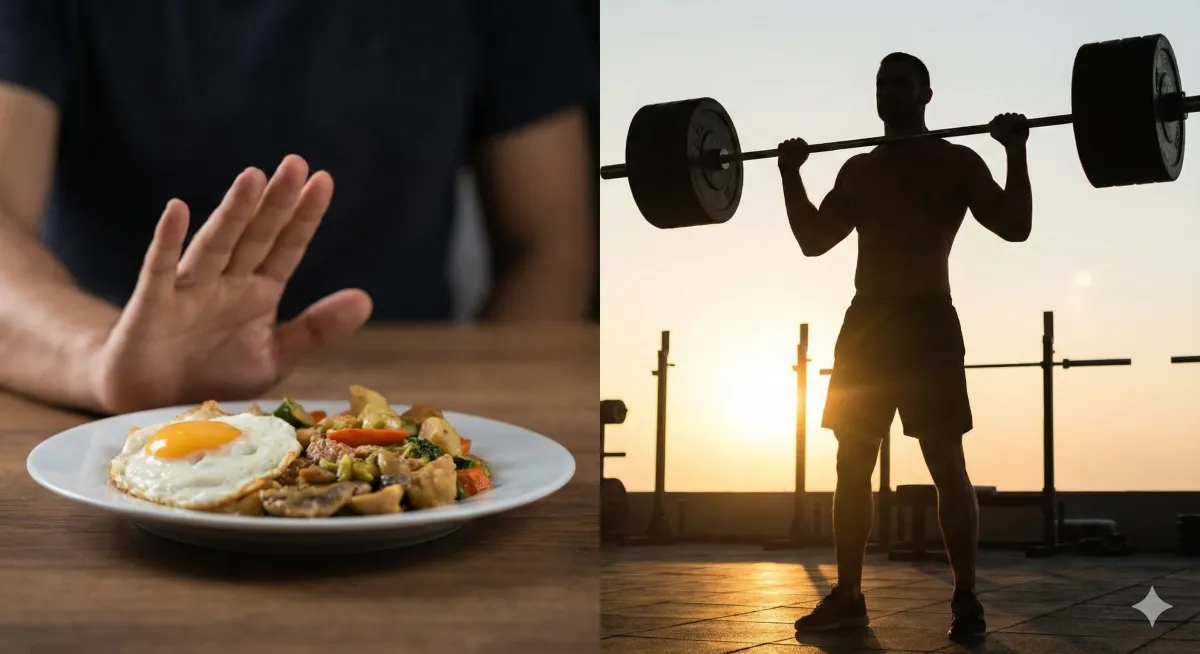
How to Build Muscle by Pushing Away the Table
The Anabolic Switch: How to Build Muscle by Pushing Away the Table
By Connor with Honor
Medical Disclaimer: The information provided in this article is for educational and motivational purposes only and does not constitute medical advice. Fasting, heavy weightlifting, and dietary changes can have significant effects on the body. Always consult with your primary care physician or a qualified medical professional before starting any fasting regimen or exercise program, especially if you have pre-existing conditions, are taking medication, or have a history of eating disorders.
Introduction: The Lie of the Three-Hour Meal
We have been lied to. For decades, the fitness industry, the supplement giants, and the food manufacturers have fed us a narrative that is keeping us fat, sick, and weak. They told us that if we do not eat every three hours, our muscles will wither away. They told us that the sensation of hunger is an emergency that must be silenced immediately.
They were wrong.
If you are reading this, you already know the benefits of fasting. You know the science of autophagy. You know that clarity of mind that comes when digestion shuts down and the brain wakes up. But you are stuck. You are stuck because when the dinner bell rings, or when the stress of the day mounts, it is incredibly hard to push away from the table. You fear that if you don't eat, you will lose the muscle you have worked for.
I am here to tell you that the opposite is true. Fasting is not just about losing fat; it is about revealing the machine underneath. It is about flipping the "Anabolic Switch."
In this comprehensive guide, we are going to dismantle the fear of hunger. We are going to look at the specific hormonal advantages that fasting gives you—advantages that the "six meals a day" crowd can only dream of. We are going to talk about how to train heavy, how to push to failure, and how to use the discipline of the fast to fuel the discipline of the iron.
Part 1: The Physiology of the Empty Stomach
To master the art of pushing away from the table, you must understand what happens when you do. Most people view the empty stomach as a deficit. They view it as a lack of resources.
This is the wrong mindset.
When you stop eating, your body does not simply shut down. It shifts gears. It moves from a state of accumulation (fed state) to a state of adaptation and preservation (fasted state). This adaptation is where the magic happens for muscle growth.
The HGH Advantage
Human Growth Hormone (HGH) is the holy grail of muscle building and anti-aging. It protects muscle tissue, burns fat, and aids in recovery.
When you are constantly eating, your insulin levels are elevated. Insulin and HGH are antagonists; when one is high, the other is low. By eating every few hours, you are effectively suppressing your body's natural production of growth hormone.
However, studies have shown that during a fast, HGH secretion can skyrocket. Some research suggests an increase of up to 500% or more during extended fasting periods. Why does the body do this? It is an evolutionary survival mechanism. If our ancestors hadn't eaten for a day, they didn't need to be weak and lethargic; they needed to be strong, alert, and capable of hunting.
By fasting, you are not starving your muscles; you are bathing them in a protective, anabolic hormone that preserves lean mass while prioritizing fat for fuel.
Insulin Sensitivity and Nutrient Partitioning
The second physiological key is insulin sensitivity. If you are overweight or if you have been overeating for years, your cells have likely become resistant to insulin. This means your body has to pump out massive amounts of insulin just to handle a moderate amount of carbohydrates. High insulin promotes fat storage.
Fasting resets this sensitivity. When you finally do sit down to eat—when you break that fast—your body is primed. It acts like a dry sponge ready to soak up water. The nutrients you consume during your refeed window are shuttled directly into the muscle cells to replenish glycogen and repair tissue, rather than being stored as visceral fat.
Part 2: The Mental Game – Pushing Away the Table
Knowing the science is one thing. Doing it is another. The hardest lift you will ever perform is not a deadlift or a squat. It is the "Table Push-Away."
Why is it so hard? Because we have conditioned ourselves to use food as a tranquilizer. We eat when we are bored. We eat when we are stressed. We eat to celebrate. We eat to mourn.
Identifying "Head Hunger" vs. "True Hunger"
You must learn to distinguish between the two.
True Hunger is a slow build. It is physical. You feel it in the pit of your stomach, but it comes in waves. It does not demand specific foods; it just demands energy. Interestingly, true hunger often disappears if you ignore it for 20 minutes and drink a glass of water.
Head Hunger is sudden. It is emotional. It demands specific textures—crunchy, salty, sweet. It is the voice that says, "I deserve this because I had a hard day."
The strategy for pushing away from the table is to treat the fast as a workout set. When you are in the gym, and you are pushing a heavy weight, your muscles scream at you to stop. They burn. They shake. But you do not drop the weight. You push through the pain because you know that the pain is the signal of growth.
Hunger is the same signal. When you feel that urge to eat when you shouldn't, recognize it as "mental hypertrophy." Every time you feel the urge to snack and you choose to drink water instead, you are doing a rep for your willpower. You are strengthening the discipline muscle.
The Protocol of Separation
To make this practical, you need to separate your life from food.
Remove the Cues: If there are cookies on the counter, you will eat them. If there is bread on the table, you will eat it. Get it out of the house. If you have family members who eat these things, create a dedicated cabinet for them that you do not open.
Change the Environment: When your eating window is closed, leave the kitchen. Do not hang out there. The kitchen is a workspace for fueling, not a lounge for relaxing.
Hydration as a Weapon: Most of the time, you are not hungry; you are thirsty. Mineral water, black coffee, and tea are your weapons. They blunt the appetite and keep the hands busy.
Part 3: Training Strategy – The Push/Pull Philosophy
Now that we have addressed the fasting component, we must address the stimulus. You cannot build muscle by fasting alone. Fasting reveals the muscle, but training builds it.
For the individual looking to maximize growth while fasting, we need a high-intensity, low-volume approach. We do not have the glycogen stores to do two hours of junk volume. We need efficiency. We need intensity.
This brings us to the Push/Pull split, utilizing sets to failure.
Why Failure Matters
If you are fasting, your body is in a conservation mode. To convince it to build muscle, which is metabolically expensive tissue, you must provide a stimulus that screams, "We need this tissue to survive!"
Stopping three reps short of failure sends a signal that says, "This was easy enough." Taking a set to absolute mechanical failure—where you cannot move the weight another inch with good form—sends a signal that says, "This was a threat to our survival. We must adapt. We must get stronger."
The Structure
We will divide the body into two primary movement patterns:
Push: Chest, Shoulders, Triceps, Quads, Calves.
Pull: Back, Traps, Biceps, Hamstrings, Abs.
You will rotate these days. If you are feeling energetic, you might do Push/Pull/Rest/Push/Pull/Rest. If you are deep in a longer fast, you might do Push/Rest/Pull/Rest.
The "5 Sets to Failure" Standard:
For each major body part, you will perform 5 working sets. These are not warm-ups. These are wars.
Sets 1-2: Heavy weight, 6-8 rep range. Failure.
Sets 3-4: Moderate weight, 10-12 rep range. Failure.
Set 5: Metabolic flush (partials/dropset). 15+ reps. Absolute Failure.
When you combine this intensity with the hormonal environment of a fast, you create a potent cocktail for body recomposition. The heavy lifting stimulates the Type II muscle fibers, while the HGH from the fast protects that tissue from catabolism.
(Note: We will detail the specific exercises and mechanics in Article #2).
Part 4: The Refeed – Eating for Purpose, Not Pleasure
You have fasted for 18, 20, or 24 hours. You have trained to failure. Now, you sit at the table. This is the most dangerous moment.
This is where the "Push Away" mentality is tested. It is easy to justify a binge. "I didn't eat all day, so I can eat this entire pizza."
No. You cannot.
If you binge on garbage after a fast, you blunt the growth hormone spike and spike insulin so high that you immediately start storing fat. You undo the work.
The Order of Operations
When you break your fast, you must do it strategically:
Protein First: Your first bite must be protein. Lean steak, chicken, eggs, or a high-quality whey isolate. This provides the amino acids necessary for repair.
Fats Second: Healthy fats like avocado, olive oil, or animal fats. This provides satiety.
Carbohydrates Last: Carbohydrates are not the enemy, but they are a tool. Save them for the end of the meal. By eating protein and fiber first, you blunt the insulin response of the carbs.
You must eat until you are satisfied, not until you are stuffed. There is a difference. Satisfied means the hunger is gone. Stuffed means you are uncomfortable. As soon as you feel satisfied, you must push away from the table. Physically stand up. Leave the room.
Conclusion: The First Step
This journey is not for the weak of mind. It requires you to go against everything society tells you about food. It requires you to be hungry and find power in it. It requires you to be tired and find strength in it.
Fasting is the ultimate tool for self-mastery. If you can control what goes into your mouth, you can control anything. You are not just building a better body; you are building a better mind.
In the next article, we will dive deep into the specific mechanics of the Push Day, breaking down the exercises that yield the highest return on investment for the fasting athlete.
Push away from the table. Pick up the iron.