Your Hormones Are Broken: How Fasting Becomes Biohacking After 40
🎯 TL;DR (Too Long; Didn't Read)
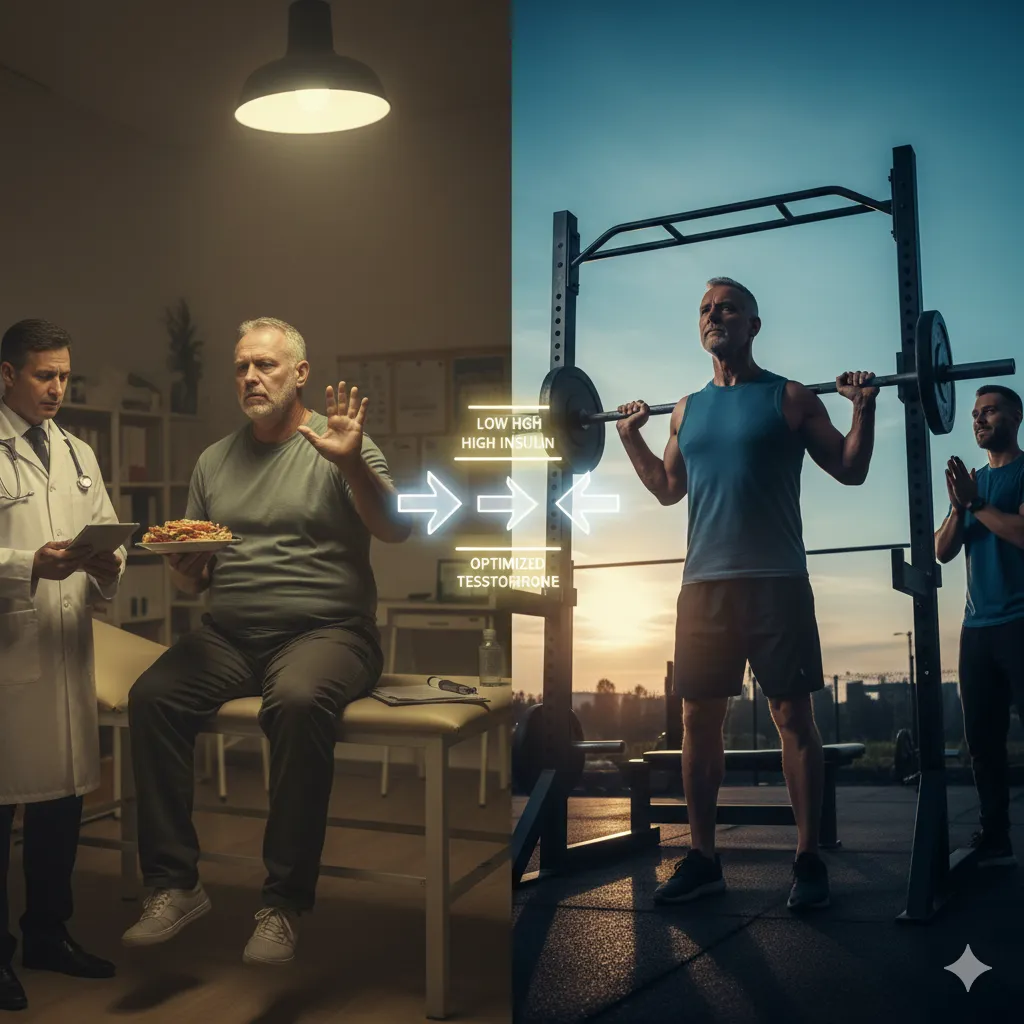
Your greatest obstacle to fat loss and muscle gain after 40 isn't calories; it's hormonal chaos. Constant feeding keeps your Insulin high, which suppresses Human Growth Hormone (HGH) and accelerates the decline of Testosterone. Fasting is the cheapest, most effective biohack available. It forces insulin to drop (allowing fat burning), naturally spikes HGH by up to 500% (preserving muscle), and sets the metabolic stage for optimal T-levels. We dissect the precise timing and nutritional tactics to turn your body from a fat-storing diabetic time bomb into a longevity machine.
The Retirement Crisis: You're Not Tired, You're Hormonally Deficient
I lived the fatigue. I carried the weight. I was a man in his early fifties—a retired First Responder—who was tired, lacked energy, and was constantly sweating. The logical conclusion was that I was "just getting older." But that was a lie. My legs were turning red and brown (Clot City), and my waist was ballooning to 65 inches. My body was in crisis.
Your body is not "just aging." It is suffering from Hormonal Chaos, a condition accelerated by years of the Standard American Diet (SAD) and the constant advice to snack every two hours.
The foundation of the Code Red lifestyle is understanding the three hormones that dictate whether you get fat, stay fat, or thrive. When you understand how they work together, you unlock the cheat code to your metabolism.
The Three Horsemen of Metabolic Chaos
1. Insulin: The Fat-Storing Gatekeeper
Insulin is not the enemy; it is simply a gatekeeper. When you eat carbohydrates or protein, insulin rises. Its primary job is to clear glucose from the bloodstream and shuttle energy into cells. When insulin is high, your body is in storage mode.
The Problem: Years of constant feeding—grazing, snacking, and consuming sugar-laden, processed foods—keeps insulin perpetually high. Your cells become deaf to its signal (Insulin Resistance), and your pancreas starts pumping out massive amounts just to cope.
The Result: You can never access your stored body fat. The gate is always locked, even if you run five miles. This is the root of Type 2 Diabetes and chronic obesity.
2. Human Growth Hormone (HGH): The Muscle Preserver
HGH is the anti-aging, fat-torching, muscle-preserving hormone. It is secreted primarily during deep sleep and during periods of deep physical stress—like intense fasted workouts.
The Problem: Insulin and HGH are antagonists. When insulin is high (which it is when you are constantly eating), HGH production is suppressed.
The Fasting Solution: Fasting forces insulin to drop to its lowest baseline. This drop signals the pituitary gland to unleash a torrent of HGH. Studies show fasting can increase HGH secretion by 300% to 500% in men, preserving your lean muscle mass while you burn fat. This is why the myth that "fasting makes you lose muscle" is fundamentally flawed.
3. Testosterone (T): The Energy and Drive Hormone
Testosterone is critical for muscle growth, energy, bone density, libido, and motivation.
The Problem: As men age (and women, though differently), T-levels decline. This decline is accelerated when men carry excessive visceral fat (belly fat). The fat cells contain an enzyme called aromatase, which actively converts precious Testosterone into Estrogen. This is a literal hormonal castration executed by your own fat tissue.
The Synergistic Fix: Fasting reduces the visceral fat that drives this conversion, while simultaneously making the remaining cells more sensitive to both T and HGH. You are lowering the fat factory that converts T to Estrogen, while boosting the HGH that preserves your muscle. This is hormonal warfare won on two fronts.
The Biohacking Blueprint: Optimizing Fasting for Hormones
If you are a man over 40 (or a woman battling metabolic fatigue), you must approach fasting not as a diet, but as a deliberate hormonal tool.
I. The Fasting Window (Insulin Suppression)
The goal of your fasting window is to drive insulin to absolute zero and keep it there long enough for the HGH spike to occur and for the body to fully shift into fat-burning (ketosis).
Fasting StyleHormonal BenefitCode Red Application16:8 (Daily Intermittent)Lowers daily insulin load. Good for maintenance and initial habit formation.Use this if you are managing hunger and maintaining low body fat.20:4 (The Warrior Fast)Maximizes time in low-insulin state, boosting daily HGH secretion.Excellent for accelerated fat torching and muscle preservation.36 to 72 Hours (Extended)Triggers peak HGH and massive autophagy (cellular repair).Use strategically every 4-6 weeks for longevity and deep healing (e.g., healing old injury sites).
The Code Red Rule: Use an extended 36-hour fast (say, Monday dinner to Wednesday breakfast) strategically to reset your insulin sensitivity. This sensitivity makes your next meal count—shuttling nutrients to your hungry muscles, not your fat cells.
II. The Refeed Window (T-Level Support)
Your food choices during the refeed are not about "cheat meals;" they are about fueling an optimal hormonal environment. You must support T-production and recovery.
Prioritize Protein: Protein is essential for muscle protein synthesis (MPS). Aim for 1.0g to 1.2g of protein per pound of target lean body mass. High protein ensures that the HGH released during the fast is used to preserve or build muscle, not just recycle old tissue.
Saturated Fats are Fuel: Cholesterol is the precursor molecule for Testosterone. Do not fear healthy saturated fats (red meat, eggs, butter, avocado). They are critical for hormone production. The Low-Fat Myth of the 80s starved our bodies of hormone building blocks.
Timing is Key: Eat within a defined window (4-8 hours). Do not graze. Grazing is the enemy of Insulin control. By eating once or twice within a compressed window, you train your body to expect and manage the insulin spike efficiently.
The Accountability Factor: Why You're Still Stuck
I’ve met thousands of people on this journey, and I’ve seen them fail not because the science is wrong, but because the psychology is weak. As I often say, I can take someone from fat to lean, but I have to be in the room and watching all the time.
1. The Full Stop is Accountability
My own maintenance protocol requires constant accountability. The moment my weight creeps up five pounds above my maintenance level, I execute the FULL STOP protocol. I don't negotiate. I don't say, "I'll start tomorrow." I stop eating, immediately. That is my personal Code Red.
This instant accountability is what breaks the years of learned self-sabotage. You must adopt your own FULL STOP mechanism and apply it with the non-negotiable discipline of a First Responder.
2. Eliminating the Toxic Trio (Food, Alcohol, Lies)
Your hormones will remain broken if you continue to consume the modern toxic trio:
Processed Sugar/Carbohydrates: They spike insulin highest and most rapidly.
Alcohol: Stops fat burning dead in its tracks and adds liquid sugar.
Lies: The lie that you can "out-exercise" a bad diet. My old self, running and lifting heavy while consuming sugary cereals, proved that lie false. Abs are made in the kitchen first and foremost.
3. Seek the Expert Intervention
If you are following the protocols and still feel tired, flat, and unable to gain muscle, you may need a medical intervention. My own journey was transformed after discovering my Testosterone levels were that of an 80-year-old man.
Action Item: Get a full hormonal blood panel. Do not accept a doctor who dismisses you with "you're within range" when you are at the bottom of the range. Seek specialists who understand biohacking and longevity. Correcting that deficiency (under medical guidance) is often the missing key that unlocks the energy required to lift, fast, and maintain a high-quality life.
❓ Q&A: Hormones, Muscle, and the Fasted State
Q1: Won't fasting suppress my metabolism?
A: No. Caloric restriction decreases your metabolism because your body senses starvation and turns down the furnace. Fasting, however, triggers an adrenaline and HGH spike that increases your metabolic rate. Studies show that fasting can actually increase your metabolism.
Q2: Is it safe for men over 50 to supplement Testosterone?
A: You must consult a doctor specializing in hormone replacement therapy (HRT). However, for men over 50 with clinically low T-levels, research suggests that bringing T into optimal ranges—under supervision—can dramatically improve muscle retention, bone density, energy, and quality of life. It’s about correcting a deficiency, not chasing bodybuilding numbers.
Q3: What is the best way to handle the constant insulin sensitivity issue?
A: The best way is prolonged fasting (24–72 hours). This is a total metabolic reset. It forces the insulin gates to close and the cells to become hyper-responsive again, reversing the resistance caused by chronic feeding.
Q4: I’m losing fat, but I feel sluggish. Is that Low T?
A: It could be. Fasting is a stressor. If you are fasting, lifting heavy, and still feel flat, check your Iron (ferritin) and your total Testosterone. Low T can make the fat-torching process feel like pure misery. Get tested.
Conclusion: The Commitment to Optimal
You have a choice: Accept the inevitable decline dictated by poor lifestyle choices, or fight for optimal health and longevity. The tools are simple: stop eating sugar, prioritize nutrient-dense protein and fat, lift heavy things, and fast strategically.
Correct your hormones, master your metabolism, and the battle against fat will become a victory for life.
Start now. Stop lying. Get to work.